
REVIEW · WALKING TOURS
1916 Rebellion Walking Tour
If you want the 1916 Rising explained in plain street language, this walk fits. You follow the story from famine-era pressure to Easter Week, with stops that let you see the rebellion up close.
International Bar to GPO is the core route, and the guide ties each landmark to the bigger political shift.
What I like most is the way the tour gives context without turning into a lecture. You get clear introductions at the start, then you hit major sites like Dublin Castle and the General Post Office where the story comes alive in your head.
One drawback to weigh: the total time can run longer than the headline estimate, especially with a full group. The walk is built for discussion, and with a maximum of 30 people, that can affect how quickly you cover each stop.
In This Review
- Key highlights if you love real, in-the-streets history
- Why This 1916 Rising Walk Works Better Than Trying to DIY It
- International Bar Start: Lorcan Collins, Early Drinks, and the Famine Setup
- City Hall and the Irish Citizen Army at Easter Week 1916
- Dublin Castle: Seeing British Administration Without the Film Blur
- Four Courts From the Liffey Bridge, and How 1916 Connects to 1922
- O’Connell Monument Bullet Holes: Where the Rising Stayed Visible
- Jim Larkin Statue: Union Ties and Working-Class Power
- The GPO and the Proclamation Moment: Easter Week’s Dublin HQ
- Moore Street and Bank of Ireland: Route Variations That Keep It Interesting
- Pacing, Weather, and What to Expect From a 2-Hour Walk
- Alcohol, Singing, and the Tone You’ll Feel on the Street
- How Much This Costs, and Why It’s Still Good Value
- Who Should Book the 1916 Rebellion Walking Tour
- Should You Book This 1916 Rebellion Walking Tour?
- FAQ
- How long is the 1916 Rebellion Walking Tour?
- Where does the tour start?
- What is included in the price?
- Is the tour in English?
- Do I need to pay extra entry fees for the stops?
- Are there drink options during the tour?
- What’s the group size limit?
- Is there a cancellation policy?
- Can children join?
Key highlights if you love real, in-the-streets history

- Lorcan Collins connection at the International Bar, a long-running 1916 guide who has led this tour since 1996
- Famine to Rising framing, starting with the Great Hunger so Easter Week has real causes
- Up-close landmark moments, including areas linked to the GPO HQ and the last stand
- Chilling physical details, like bullet holes you can still spot at monuments on the route
- A talk-style tour, with time for questions and storytelling that feels conversational
- Culture extras, since alcohol is available and singing or poetry may show up depending on the guide
Why This 1916 Rising Walk Works Better Than Trying to DIY It
Dublin is full of plaques and named streets, but the 1916 Rising can feel like a jumble if you try to piece it together alone. This tour is designed to put the timeline in your hands early, so you can connect the street-level sights to the people and decisions that shaped them.
You also get something you cannot easily replicate on your own: a guide who can steer you through the political logic, from long-term hardship to the dramatic decisions of Easter Week. The result is that you leave with a clearer sense of why events happened, not just what happened.
More Walking Tours in Dublin
- Dublin Highlights and Hidden Gems Guided Walking Tour
★ 5.0 · 6,020 reviews - Dublin: Highlights and Hidden Gems Walking Tour
★ 4.9 · 2,140 reviews - 90 Minute Dublin Walking tour and Sightseeing tips
★ 5.0 · 916 reviews
International Bar Start: Lorcan Collins, Early Drinks, and the Famine Setup
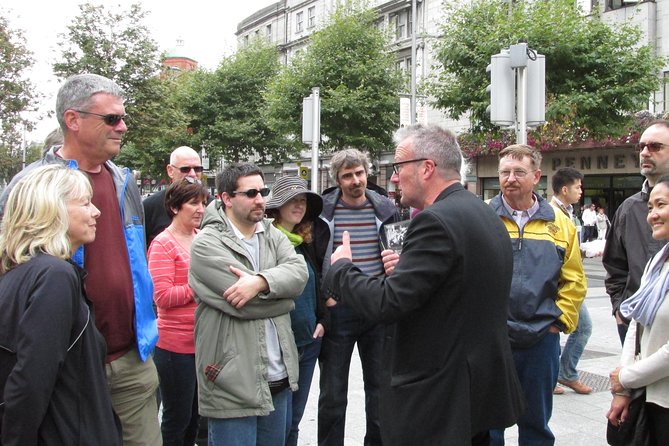
The walk begins at 23 Wicklow St, at the International Bar, where guide Lorcan Collins has run the 1916 Tour since 1996. If you arrive early, you can grab a drink and browse the introductory literature your guide provides. That early time is more than waiting room comfort, it helps you get oriented before the story starts moving.
The tour kicks off with a short build-up to the revolutionary period, starting with the Great Hunger in the 1840s and working forward to the 1916 Rising. I like this approach because it treats 1916 as the end of a long pressure-cooker, not a sudden lightning strike. You are also encouraged to ask questions right away, which turns the walk into a two-way conversation instead of a one-direction speech.
Practical tip: if you are sensitive to cold or rain, the start at the bar is your cue to bundle up. Once you are outside, you are on streets for the bulk of the experience.
City Hall and the Irish Citizen Army at Easter Week 1916
One of your first official stops is City Hall, and this is where the tour shifts from background into the week itself. You pause to talk about how the Irish Citizen Army occupied the building during the Rising, and what that meant in the wider Easter Week picture.
This stop is valuable because it adds texture to the usual headline names. You get a sense of how different groups operated in parallel, and how the rebellion used real civic spaces rather than only imagining action in the abstract.
Time here is brief, so go in ready to listen closely. You will get the most out of City Hall if you treat it like a checkpoint in the story, not as a standalone attraction.
Dublin Castle: Seeing British Administration Without the Film Blur
Next up is Dublin Castle, the British administration center that controlled Ireland for a long stretch. The guide explains the role Dublin Castle played during the 1916 Rising and the later War of Independence, so you can see how authority, conflict, and strategy connected across years.
If you have seen the Michael Collins movie, Dublin Castle may feel familiar, but this stop is about what the location represented in real political terms. You are not just looking at architecture, you are learning why the building mattered to both sides.
A small caution: Dublin Castle is a big, active area. You might want to check your footing and keep your attention on the guide, because the setting can pull your eyes in multiple directions at once.
A different sort of day out in Ireland:
- Dublin to Cliffs of Moher, including Wild Atlantic Way and Galway
★ 5.0 · 23,331 reviews - From Dublin: Cliffs of Moher, Burren & Galway City Day Tour
★ 4.8 · 18,888 reviews - Dublin: Guinness Storehouse Entry Ticket
★ 4.6 · 16,863 reviews - Dublin to Cliffs of Moher, Burren, Wild Atlantic Way, Galway Tour
★ 5.0 · 12,924 reviews
Four Courts From the Liffey Bridge, and How 1916 Connects to 1922
At Four Courts, the focus is on occupation during the Rising and again during the run-up to the Irish Civil War in 1922. You do not necessarily go right up to the building, and that is for a reason: the tour is best experienced with the structure in view from a bridge over the River Liffey.
This is one of those stops that proves the tour is practical. A bridge view keeps the history in frame while you hear the guide explain the role of Four Courts in both 1916 and 1922, plus the political intricacies that later led to civil conflict.
If you like cause-and-effect, you will enjoy this part. It helps you understand how a rebellion can evolve into a new set of battles when the end goals start to clash.
O’Connell Monument Bullet Holes: Where the Rising Stayed Visible
You stop at O’Connell Monument, and this is where the tour gets uncomfortably real. The guide explains the bullet holes still visible and discusses the positions occupied by the British and Irish forces in 1916.
I love stops like this because they short-circuit the distance that history sometimes creates. Instead of feeling like you are reading about events from a textbook, you get a physical reminder that violence left marks on stone, not just on pages.
There are usually little moments along the route too, so if you find yourself wondering what you are learning in between major sites, you are probably in the right place. This tour uses those pauses to tighten the narrative.
Jim Larkin Statue: Union Ties and Working-Class Power
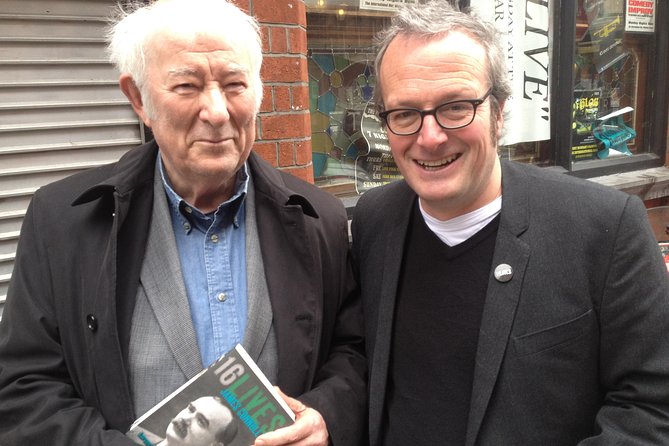
Another powerful stop is at the Jim Larkin Statue, where you learn about Big Jim Larkin and his connection to James Connolly. Larkin is presented as a comrade of Connolly and a supporter of the Dublin working class, which adds a social layer to the political story.
This matters because the 1916 Rising was not only built out of secret meetings and dramatic speeches. It also involved workers, unions, and networks of support, and Larkin helps you see that side.
If you are the type of traveler who loves the human networks behind big events, this stop will land. It turns the story away from only leaders and toward the broader coalition.
The GPO and the Proclamation Moment: Easter Week’s Dublin HQ
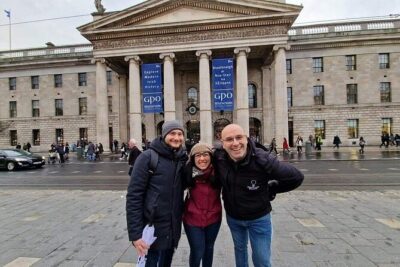
The An Post General Post Office (GPO) is the heart of the tour. This is the headquarters for the revolutionaries in Dublin, and it is also where P. H. Pearse read the Proclamation, making it an integral part of Irish national memory.
You spend about 30 minutes at this stop, which is plenty of time to let the guide build the meaning. You do not just hear dates and names. You get an unfolding explanation of how Easter 1916 played out and why this building became symbolic.
This is also a stop where your questions tend to get more pointed. If you want to understand the mindset behind the rebellion and the stakes as it unfolded, this is where you can ask, and where your questions usually make sense to the story already on your mind.
Moore Street and Bank of Ireland: Route Variations That Keep It Interesting
Depending on timing, the tour may go on to Moore Street. Here you learn about where the GPO garrison made their last stand, giving you a sense of how the fighting moved through Dublin during Easter Week.
Then, depending on the route that day, you might also stop near the Bank of Ireland, known more colloquially as the Old Parliament. The guide explains its role in Irish history and its relationship to nearby Trinity College.
Two useful things about these variations:
- You are more likely to see the most relevant route for the day’s timing.
- The tour does not feel copy-paste, even if you have been around Dublin’s history scene before.
If you are traveling with limited time in Dublin, the core sites still matter. These “maybe” stops mainly affect how complete the street-level picture feels.
Pacing, Weather, and What to Expect From a 2-Hour Walk
The tour is listed at around 2 hours, and many people find the pace smooth. Still, one practical note matters: some groups report it can take closer to 3 hours when the guide spends extra time on questions and stops linger a bit.
The group size is capped at 30, which is a comfortable maximum for listening on a walking route. But it also means you should expect a shared pace. If you are the type who likes to sprint between stops with a quick skim of signage, this might feel a bit slow. If you like to learn while you walk, it will feel just right.
Weather matters too, since the experience requires good weather. If conditions are rough, plan for possible rescheduling or a full refund offer.
Bring what you need for street time: good walking shoes and a jacket you can handle if the air turns.
Alcohol, Singing, and the Tone You’ll Feel on the Street
Alcohol is not included, but the tour notes that alcoholic drinks are available to purchase. That matters because the International Bar start sets a relaxed mood. You are learning serious history, but you are not locked into stiff museum behavior from minute one.
Several guides incorporate performance elements like singing old rebel songs or using poetry as part of storytelling. You might hear it during your walk, depending on your specific guide and timing. Either way, the tone stays respectful, and the goal is clarity, not gimmicks.
One more value point: because drinks are optional, you can choose your comfort level. You can also keep your head clear for the questions you might want to ask at places like the GPO.
How Much This Costs, and Why It’s Still Good Value
At $27.81 per person for about 2 hours, the price is low compared with many themed tours in major European cities. The key reason is that you are paying primarily for a professional guide who turns multiple major landmarks into one connected story.
You are also not paying for entrance tickets at the stops listed. The tour notes admission ticket free for the major sites you visit, which keeps your spending focused on the guide experience rather than a stack of extra costs.
If you like tours that give context and connections, this is one of the more budget-friendly ways to get that in Dublin. If you already know Irish history in detail, you might get less incremental learning, but even then the street-level details like bullet holes are hard to replicate solo.
Who Should Book the 1916 Rebellion Walking Tour
Book it if you want more than a quick stop photo. This walk is best for people who enjoy storytelling, want the political background, and like seeing landmarks up close while the timeline makes sense.
It is also great for history buffs, but it does not require prior knowledge. The build-up from the Great Hunger through Easter Week is designed to bring you in at the start, so you are not lost at the first stop.
You should consider something else if you strongly dislike group tours or long listening sessions. Also, if you need exact minute-by-minute pacing, plan for flexibility. This is a conversation tour, and that is part of the charm.
Should You Book This 1916 Rebellion Walking Tour?
Yes, you should book it if you are in Dublin and you want a clear, human-sized way to understand the 1916 Rising. The value comes from how the guide connects major landmarks into one timeline, with time for questions and moments that stay with you, like the bullet holes at O’Connell Monument and the Proclamation context at the GPO.
I would only skip it if you already feel fully confident about the sequence of events and you prefer self-guided sightseeing with minimal narration. Otherwise, this walk is a strong use of a couple hours, and it gives you a Dublin you can actually read.
FAQ
How long is the 1916 Rebellion Walking Tour?
It runs for about 2 hours, though the walk can vary based on route and discussion time.
Where does the tour start?
It starts at 23 Wicklow St, Dublin, D02 VH59, Ireland, at the meeting point. The tour ends back at the meeting point.
What is included in the price?
A professional guide is included. You may purchase alcoholic drinks, but those are not included.
Is the tour in English?
Yes. The tour is offered in English.
Do I need to pay extra entry fees for the stops?
The listed stops are shown as Admission Ticket Free, meaning you should not need extra site tickets for those viewpoints.
Are there drink options during the tour?
Yes. Alcoholic drinks are available for purchase, with the International Bar as the start point.
What’s the group size limit?
The tour has a maximum of 30 travelers.
Is there a cancellation policy?
There is free cancellation, with full refund available if you cancel up to 24 hours in advance. Weather issues can also lead to a different date or a full refund.
Can children join?
Yes, but children must be accompanied by an adult.
Freshly listed around Dublin
- Wicklow: Private Day Tour from Dublin★ 5.0 · 5 reviews
- Wicklow Mountains Private Day Tour including Glendalough★ 5.0 · 7 reviews
- Women Of Ireland: Trailblazers & Pioneers★ 5.0 · 4 reviews
- Full Day Private Wicklow Tour★ 5.0 · 12 reviews
- Wicklow tour of Glendalough★ 4.5 · 8 reviews
- Wicklow Mountains & Glendalough Luxury Private Day Tour★ 5.0 · 23 reviews
- Premium Irish Whiskey Tasting Hosted by Local Dublin Expert★ 5.0 · 77 reviews
- Whiskey Tasting Tour of Dublin★ 5.0 · 117 reviews
Walking Tours, compared.
Dublin Highlights and Hidden Gems Guided Walking Tour
Read our review →
90 Minute Dublin Walking tour and Sightseeing tips
Read our review →
Historical 2-Hour Guided Walking Tour of Dublin
Read our review →
Dublin Traditional Irish 3 Course Meal Walking Tour with Local
Read our review →
Browse the lists this tour appears in